The story
Could a jet engine hold an aircraft up without wings? In the early 1950s, Rolls-Royce set out to find out at Hucknall.
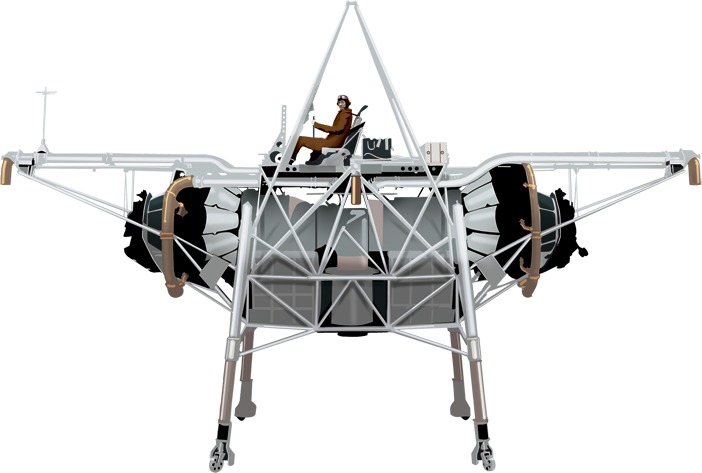
The idea came from Dr Alan Arnold Griffith, a pioneer of gas turbines who joined Rolls-Royce in 1939. He believed jet thrust could lift an aircraft straight up. To prove it, Rolls-Royce built a research machine at Hucknall: the Thrust Measuring Rig, or TMR.
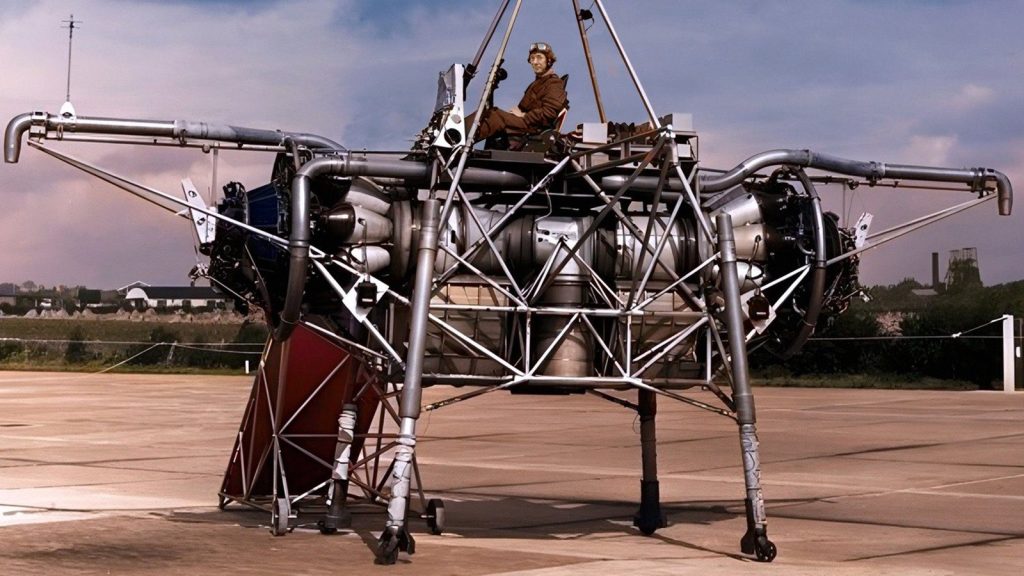
With its four legs, open steel frame and pilot perched on top, it looked more like a piece of furniture than an aircraft. Everyone called it the Flying Bedstead.
How it flew
Two Rolls-Royce Nene turbojets sat back to back inside the frame, with their exhaust turned to blow straight down. There were no wings and no rotor: all of the lift came from jet thrust.
Keeping it level was the hard part. Air bled from the engines was piped out to small “puffer” jets on the outriggers, which the pilot used to balance and steer. An auto-stabiliser designed by the Royal Aircraft Establishment helped keep it steady.
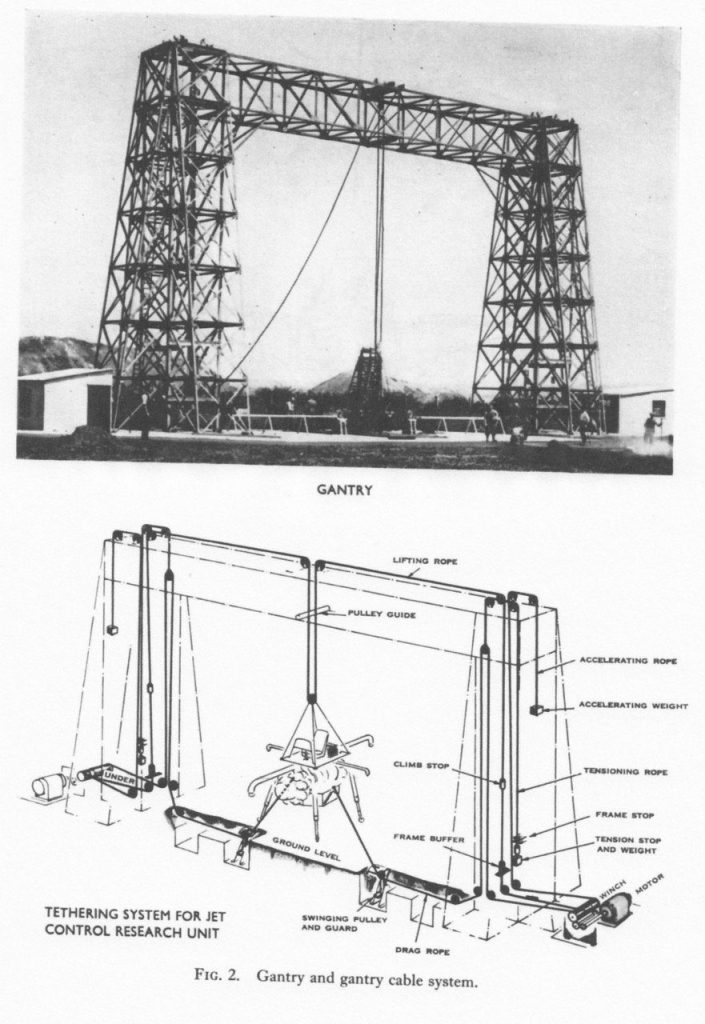
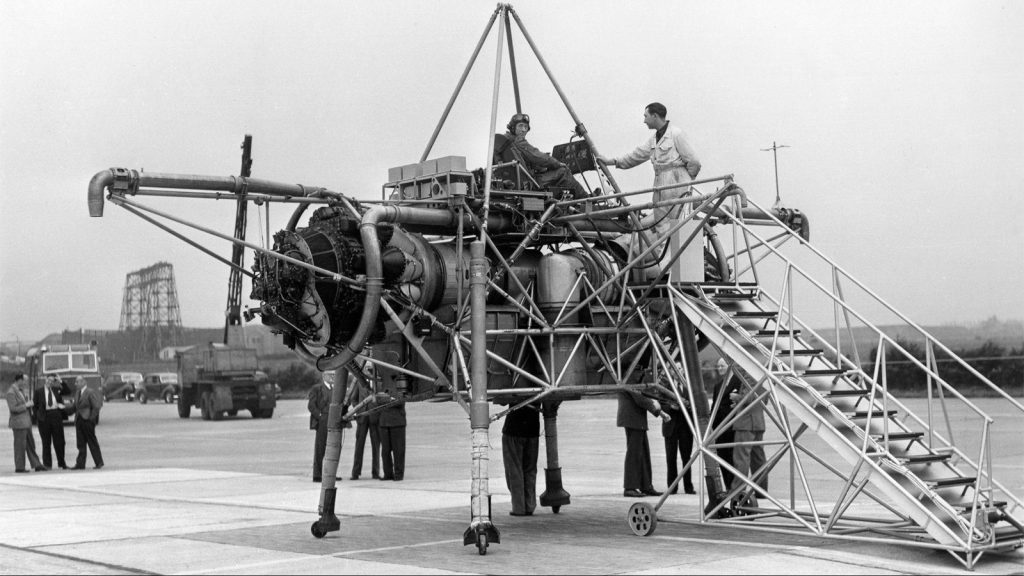
For the first year the rig flew tethered inside a tall gantry, which let it move freely but stopped it straying too far or dropping too fast. Its first tethered flight was in 1953. Then, on 3 August 1954, Rolls-Royce chief test pilot Captain Ronald Shepherd took it up for its first free flight. It rose, hovered, moved sideways and backwards, and set back down.
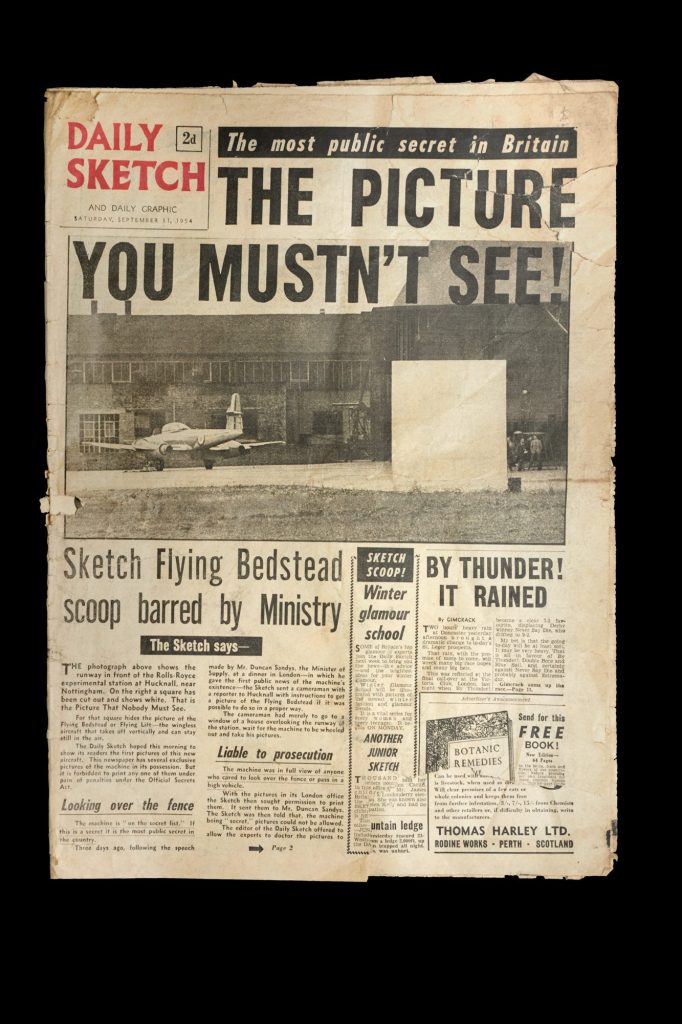
The Fire Brick Pad
The Bedstead is part of Hucknall’s story, and now it’s coming home. Clowes Developments, owners of Harrier Park, are working with the museum and Ashfield District Council to create a dedicated heritage area on the site where the Bedstead flew.
The centrepiece is the Fire Brick Pad monument, currently under construction and sponsored by Clowes. The QR code on the monument brings visitors straight to this page.
Coming in 2026
We’ll add the full story of the pad here, with construction photographs and archive material from the museum’s collection.
Legacy
The Bedstead proved that jet-lift flight was possible, and showed engineers what it would take: fast-responding engines and artificial stabilisation in the hover. After its Hucknall trials it went on to further research with the Royal Aircraft Establishment.
Two rigs were built. The second, XK426, crashed in November 1957, killing its pilot, Wing Commander H. G. F. Larsen. The first, XJ314, survives today in the Science Museum in London.
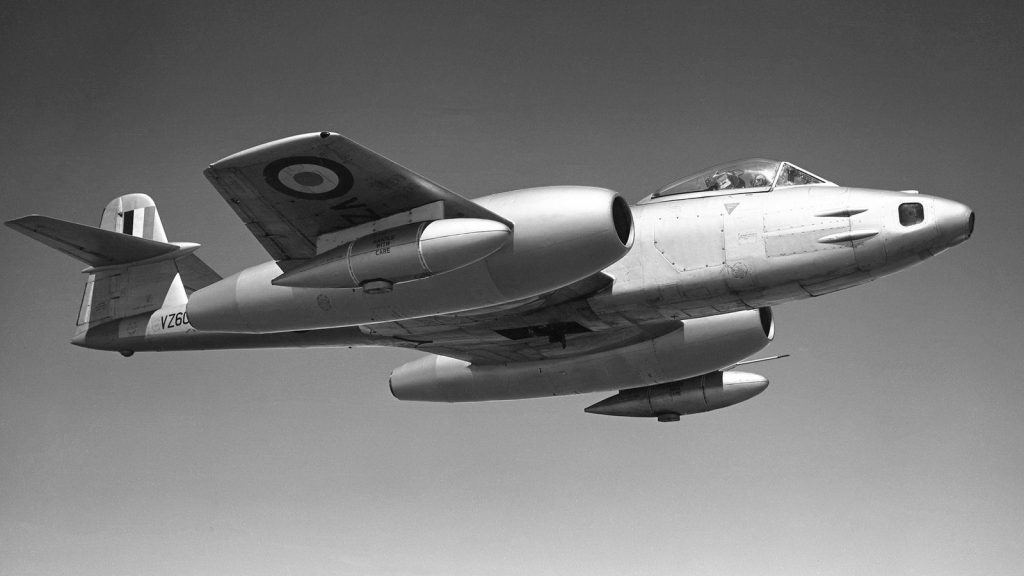
Lessons from the Bedstead fed into the jet-lift research that followed, including the Rolls-Royce RB108 lift engine tested at Hucknall in Meteor VZ608 and flown in the Short SC.1, and eventually into the Harrier jump jet. Harrier Park takes its name from that legacy.
Visit the museum
There’s much more to discover inside the Wing Hangar, just down the road. We’re open Wednesdays and Saturdays from April to October, and entry is by donation.